
Agnès Varda: 22: Mur murs
a film by Agnès Varda / 1980

The following was originally posted at the old place on November 26th, 2022.
Shaking Through
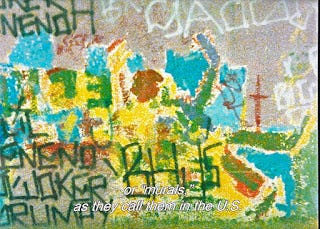
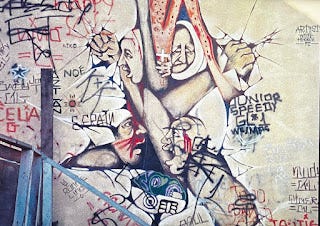
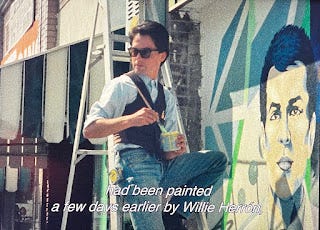
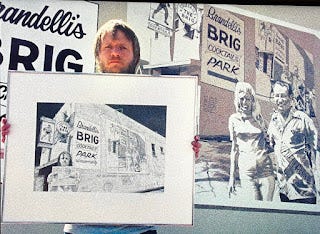
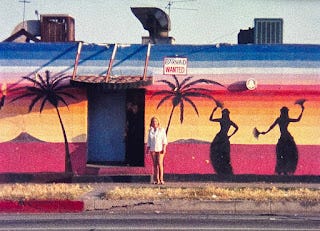
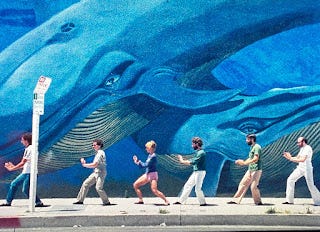
The title of Varda’s 1980 essay film, Mur murs, or Wall Walls, is a pun on the French word “Murmures,” or “Murmurs.” The walls in question are the concrete canvasses for murals and graffiti — with the former, a community celebration and homage to a man, woman, or group; with the latter, the signature that reads “I was here.” This is California Lascaux, in which rudimentary representations of “movement(s)” become reincarnated in the trompe-l’œil. This is SoCal vertigo — a vertiginous reaction to Manhattan’s domineering skyscrapers must in East Los Angeles be induced at the third-story level.
Anonymity and braggadocio: when a work goes beyond a simple tag (or a less simple stacked pile of tags) it often contains a signature in the lower-right. A male voice in voice-over intones — murmurs — the surnames of the artists.
Mur murs portrays the flotsam of the Sixties. The divide consists of thirteen years, more or less; these walls were made for talking. Used to talking from the moment of their inception. Hieroglyphics — more or less. Watching Mur murs one might be forgiven for believing it takes place in 1968. An archaeological site, seen from 1980; seen from 2022, 1980’s 42 years old. The Sixties never left, the Sixties don’t know they’re past, but they’re waiting for their next turn to speak. “The flower children who sought to beautify life?...”
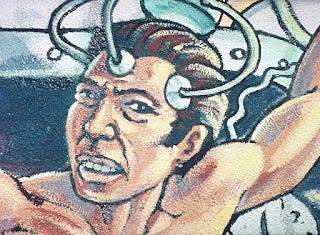
Kent Twitchell’s monumental portraits demarcate these boundaries of the time gap; the subjects of some of his paintings step forward in a tableau organized by Varda only a short time, presumably, since their likenesses had been painted by Twitchell. And yet: “Time and love have branded me with their claws...” Varda certainly caught that paint-scratch fever: due to her short stature, she has always been obsessed with monumentality in her work, like in that excursion with French goof JR. To her credit, Varda historically handed a torch to whoever excited her own excitements. She is implicitly gleeful to discover that Thomas Edison was né Álvarez, and that’s whence he adapted the middle name “Alva.” Varda draws the connection between Edison not only as arguably the creator of the cinema, but as the inventor whose efforts made a science-fiction conceivable — and in a daisy-chain sort of way laid the groundwork for a Chicanofuturism.
Question: “Who pays for it all?” — “In Jane’s case, there are grants.”
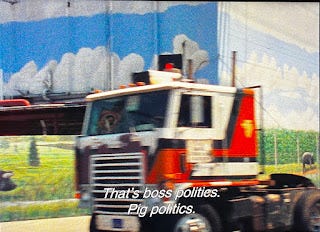
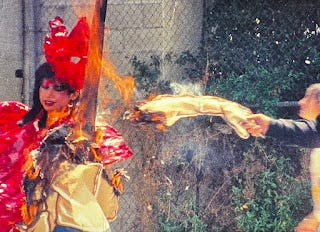
“It’s virtually creating fanatics out of normal people.” — The blade has two edges, though. There’s the apotheosizing of the landscape vis-à-vis the view-blocking trompes-l’œil; there’s 1960s-80s Los Angeles, where the “image” comes home to roost... or to die. Flip your eye, or roll the die... •
Writing at Cinemasparagus on the films of Agnès Varda:
Ô saisons ô châteaux [O Seasons, O Châteaux] [1957]
L’Opéra-Mouffe, carnet de notes filmées rue Mouffetard à Paris par une femme enceinte en 1958 [The Opéra-Mouffe: Diary Filmed on the rue Mouffetard in Paris by a Pregnant Woman in 1958] [1958]
Du coté de la Côte [Around the Côte] [1958]
Les fiancés du Pont Mac Donald, ou (Méfiez-vous des lunettes noires) [The Fiancés of the Pont Mac Donald, or: (Beware of Dark Glasses)] [1961]
Cléo de 5 à 7 [Cléo from 5 to 7] [1962]
Salut les Cubains [Hail, Cubans] [1964]
Fragments et méteorites d’un documentaire tourné pour l’ORTF en 1964: Agnès et le bonheur [Fragments and Meteorites of a Documentary Shot for the ORTF in 1964: Agnès and Happiness, 1964/2006]
Elsa la Rose [Elsa the Rose] [1966]
Les créatures [The Creatures] [1966]
Pier Paolo Pasolini - Agnès Varda - New York - 1967 [1967/2022]
Lions Love… and Lies / Lions Love [1969]
Réponse de femmes à une question produite par Antenne 2 pour le magazine ‘F. comme Femme’ [Women’s Response to a Question Put Forth by Antenne 2 for the Magazine-Show ‘F. comme Femme’] [1975]
Plaisir d’amour en Iran [1976]
L’une chante l’autre pas [The One Sings the Other Doesn’t] [1977]