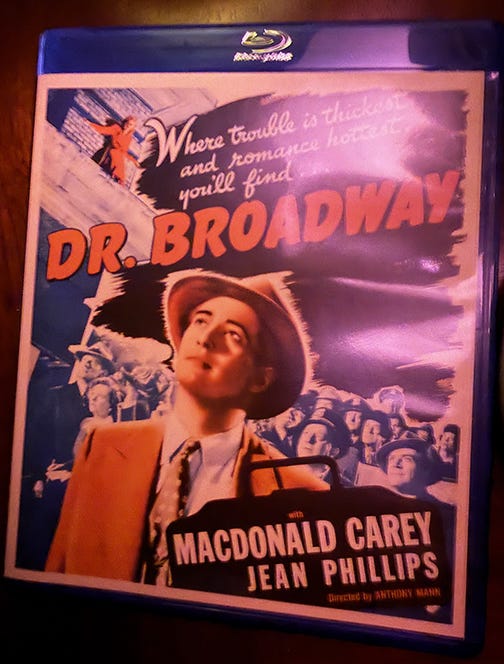
Anthony Mann: 1: Dr. Broadway
a film by Anthony Mann / 1942

The Broad and the Narrow
Anthony Mann’s first film, Dr. Broadway, was made on assignment within Paramount Studios’ lower-budget “B” unit, and upon completion impressed production overseer Sol C. Siegel enough he ordered it enter theatrical circulation as a “programmer,” that is, a motion picture perceived as of high enough ‘general audience standard of quality’ that it may be projected as either main feature or second-billing at the discretion of the exhibitor. Mann accepted the project coming directly off of his time as an assistant to Preston Sturges and a bunch of other directors with contracts at the studio, — for before arriving in Los Angeles he had taken up practically every position within the scattershot stock-theater world of New York. If Vincente Minnelli within this same period developed the process transferring his specialized Broadway chops to the Southern Californian soundstages, Mann’s own experiences and intellectual pursuits distinguished his particular arc of journeyman crew member turned reliable, and eventually very successful, studio director.
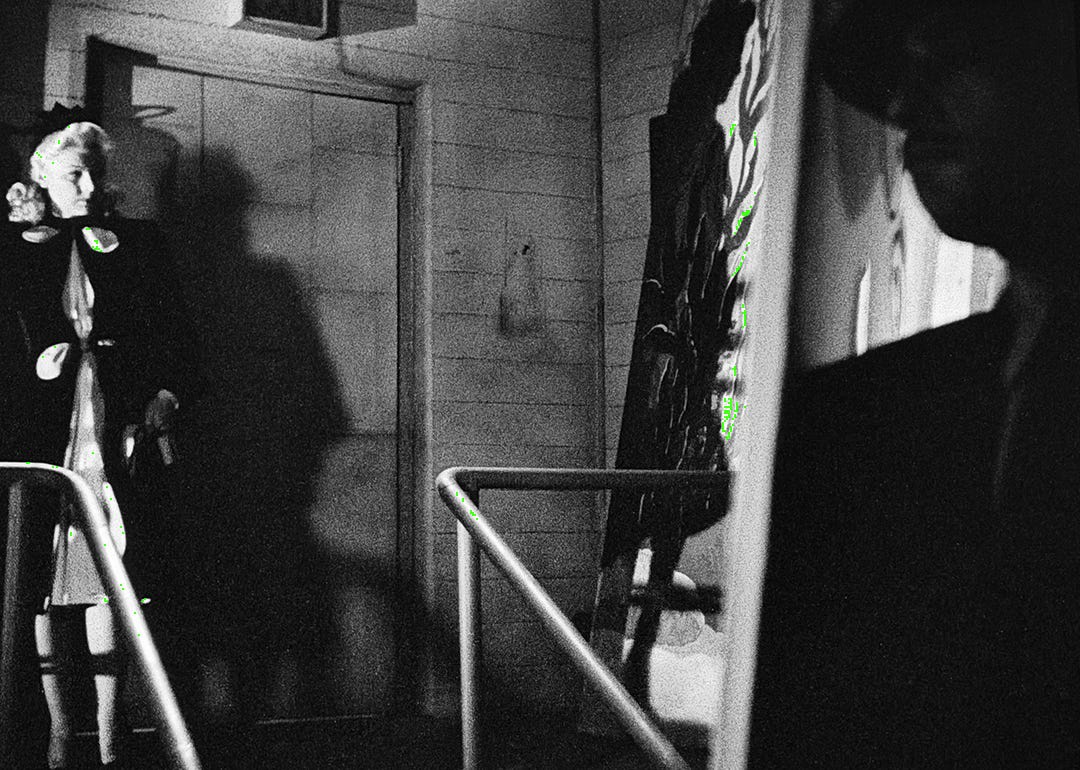
Eventually Mann would realize, or knead plastically into his pictures, his own personal vision of Space for character action to materialize-itself-within on different points, of a Space in (or a Space that is) the frame that there manifests and, perhaps in form alone, takes the occasion to overtake the intensity of the human psychologies suggested by the scripted dialogue. The exposition of space begins here, in Dr. Broadway, with a not overly concerted succession of oblique planes that nevertheless complicate the perceptions attained in the point of view among onscreen characters and movie spectators.
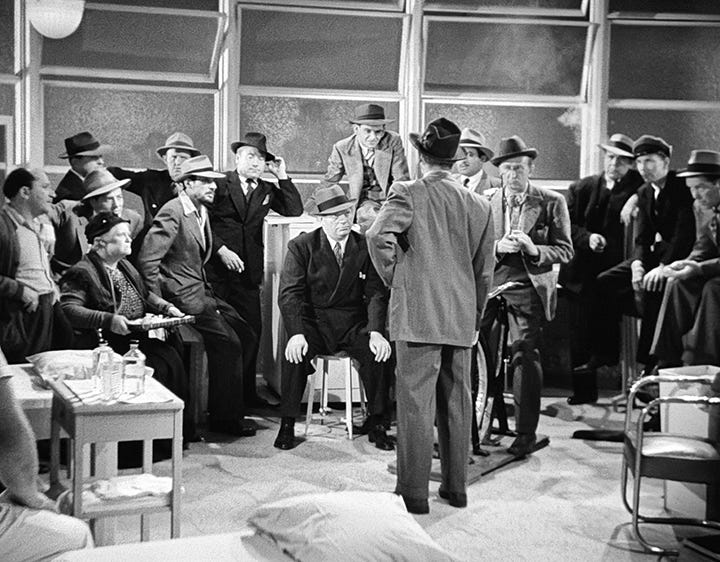
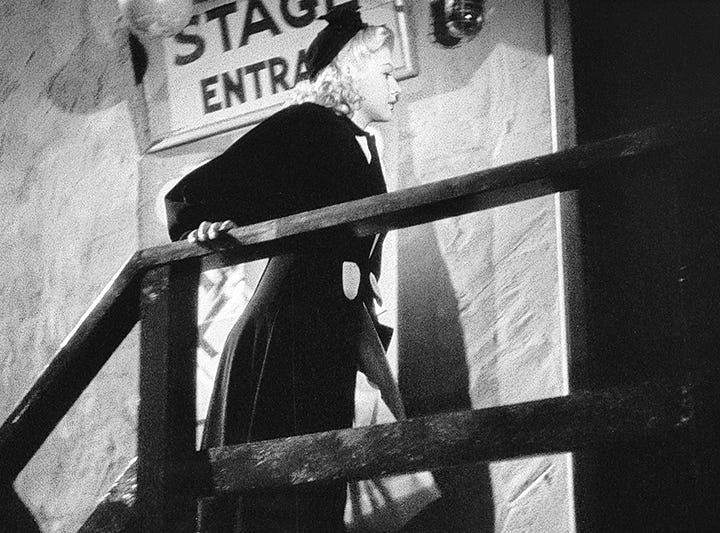
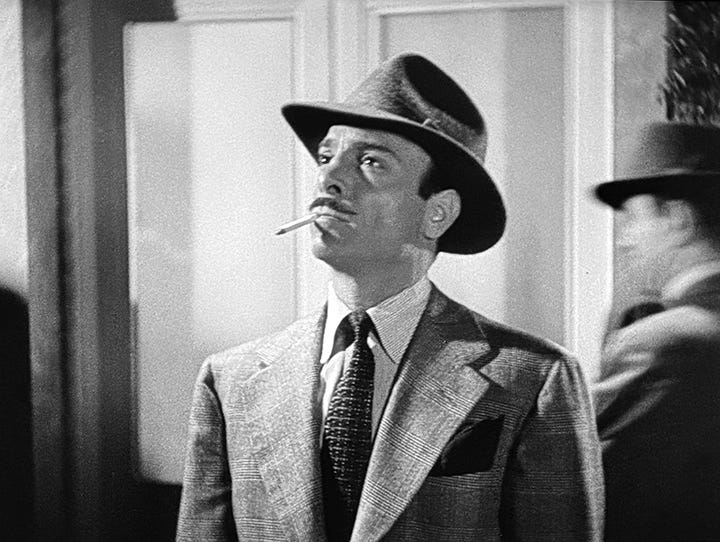
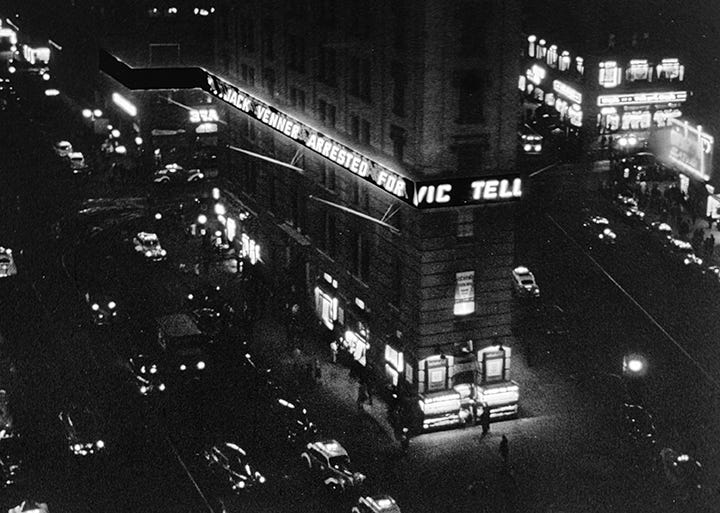
As a lightly dramatic story (adapted from the production’s purchase of rights to three Borden Chase short stories featuring the “Dr. Broadway” character), the film holds an entertaining tone, the always presented hum of city traffic, and so on a commercial level it succeeds. I’ve seen the film twice and the story, so far as I can twice tell, involves a mix of mid-rate hotel rooms and undecorated apartments. It’s a World’s Fair corner exhibition of a city like 1940s-movie-New-York. The country’s not at war, it appears. Soon to be enlisted officer and B-grade lead Macdonald Carey (best known as the detective that a year later gets close with Teresa Wright in Hitchcock’s Shadow of a Doubt, before going on to an alcoholic blitz and gaining second fame on daytime TV soap Days of Our Lives) portrays Chase’s Dr. Broadway (actual surname “Kane”) who might be a doctor, might be a Doctor Roberts even, a detective, a man respected around this and that block, what do you want to know, a man who might in fact know what he himself has got to do, the calculating fellow not making too much of a rush of it, here in the mix with a crowd gathered round an emergency force tasked with catching when it drops the body of a bleach-blonde beauty named Connie (flash-in-the-pan Jean Phillips) up clinging to a building exterior stories high, threatening to leap to the pavement. A publicity grift it turns out, but first Carey climbs out on the window ledge to save Connie, some Hitchcock heights-play here forecasting, next there’s a corrupt tailor of men’s suits, a backroom card game at Broadway’s place, a few of the well-known Italian-American / assorted tough guy actors of the time, then a side-office medical lab with a mad-doctor sunlamp that cooks sketchy Vic Telli after he’s already been shot dead and left there baking. A lot of murder business before Dr. Broadway concludes, Jean Phillips retakes the ledge for a reason unclear to me, some puckers with Macdonald Carey, give my regards, and so on. •